
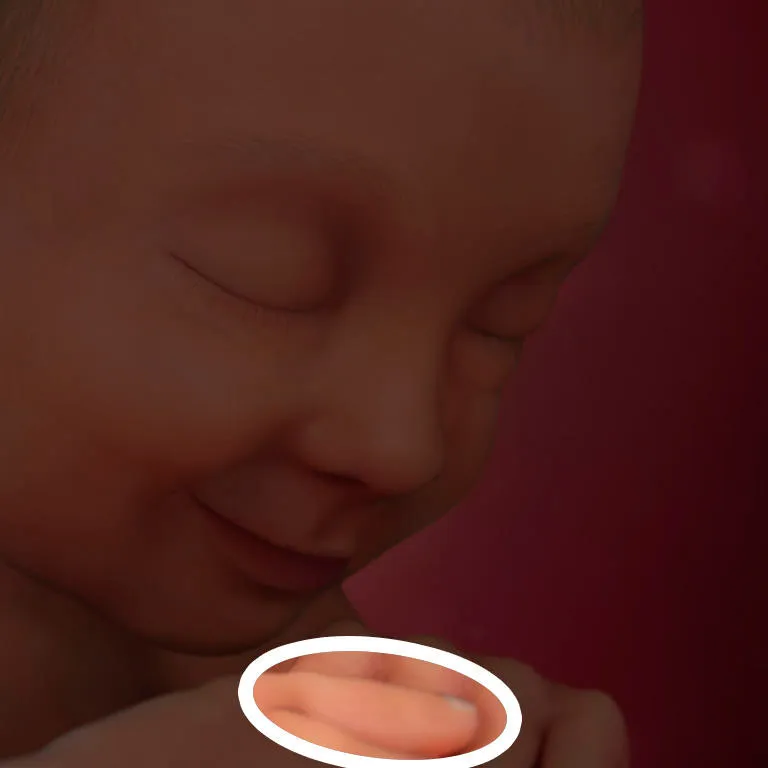

The baby is considered full-term. Lungs are ready for independent breathing.
Signs of labor (mucus plug discharge) may appear.
Pregnancy week 37 — another week of full readiness! If this is your first pregnancy, you will most likely reach the fortieth week and give birth as planned. If you already have children or are carrying twins, you may give birth as early as week 37.
However, this is not considered preterm birth. From this point on, according to medical standards, your pregnancy is regarded as full-term.
Baby’s Weight at 37 Weeks of Pregnancy
At 37–38 weeks, the baby is already ready to be born. Giving birth at 37 weeks is not uncommon in obstetric practice. The baby may even be “trying” to be born sooner: all body systems are ready to start functioning, the hormone cortisone, which supports lung maturation, is developing, a small amount of meconium (the first stool) has accumulated in the intestines, and the circumference of the baby’s abdomen and head are almost the same.
At this stage, the baby’s length is about 48–50 cm, and the weight is approximately 2.8–2.9 kg. In appearance, the baby already closely resembles a newborn we are familiar with.
The body continues to develop: all nerves are being covered with protective sheaths, and this process will continue even after birth, throughout the first year of life. The cartilage of the ears and nose is hardening, and hair has grown on the head.
By this time, hair length reaches 0.5–4 cm. Lanugo (fine body hair) should disappear, while the vernix caseosa (protective creamy coating) may cover the entire body or remain only in skin folds.
Sensations at 37 Weeks of Pregnancy
At 37 weeks, signs of approaching labor may appear: the passage of the mucus plug (yellowish discharge with streaks), the lowering of the abdomen (the baby is moving toward the exit), and mild loosening of the stool.
The uterus has reached its maximum size: its weight is about one kilogram, and its volume is 4–5 liters. The upper part of the uterus is now located 37 cm above the pubic symphysis and 16–17 cm above the navel. Pressure on the bladder increases, stabbing pain may appear in the legs and perineal area, the lower back may feel as if it is breaking, and the abdomen may harden several times a day.
The placenta, which will soon complete its function, is “aging.” The baby will be born, and the placenta will follow. Midwives record the delivery of the placenta and the successful completion of labor — nothing unnecessary remains in the mother’s body.
Pregnancy Week 37. The discharge has a stretchy, mucus-like consistency. At 37 weeks of pregnancy, pinkish-yellow discharge and dark mucus clots are typical — all of these are the first signs of the mucus plug separating, which seals the entrance to the cervix.
Pregnancy Week 37. At this stage, the uterus may be in a state of hypertonus, which can provoke labor earlier than expected. The lowering of the abdomen may also indicate that labor is approaching. Listen to yourself — be attentive, as sensations at 37 weeks can be completely different.
Doctor, What Do You Say?
At this stage, the doctor examines the vagina to determine whether amniotic fluid is leaking. The doctor assesses how soft and thin the cervix has become and checks the degree of cervical dilation — it may have already begun.
During labor, the cervix becomes so smoothed out that its walls thin significantly, allowing the baby to pass through the birth canal. Experienced obstetricians assess dilation “by fingers”: dilation to four fingers corresponds to four centimeters. However, before labor begins, the cervix usually does not open more than one finger.
Another important part of the examination is determining how the baby is positioned and assessing the width of the pelvis.
Childbirth at 37 Weeks of Pregnancy
Realizing that the time of birth is steadily approaching can cause excitement and mild anxiety in the mother. “How will everything go? What will I feel? Will everything be okay? I just want it to be quick and painless — I don’t want to feel anything” — these are natural thoughts for a pregnant woman during the final weeks.
There is no need to panic or emotionally exhaust yourself. Focus on an important task. This is not just an ordinary event — it is one of the most significant and honorable moments of your life. Hold on to the most joyful thought: very soon you will meet your long-awaited baby. Do not be afraid — with God’s will, everything will go well.


Comments (0)
There are no comments yet. Be the first to comment!
Log in to leave a comment.
Login