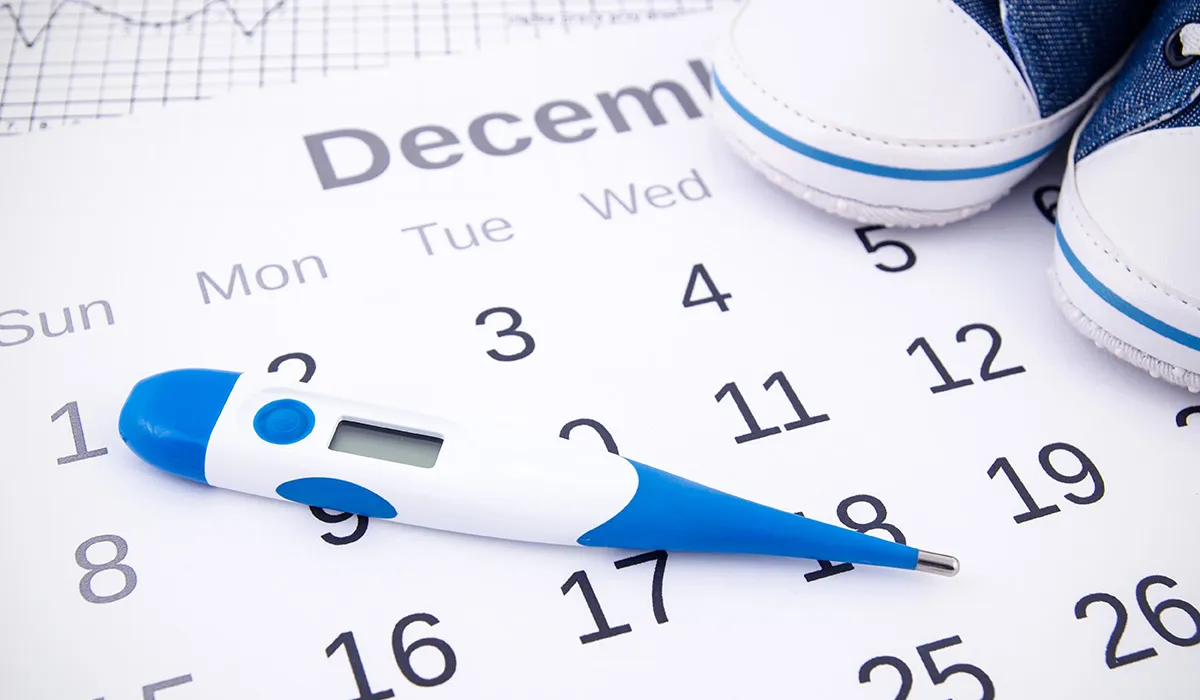
Not all women know what ovulation and the ovulation calendar are. Most often, they encounter this concept at the beginning of sexual life, since this knowledge helps either to become pregnant or, on the contrary, to prevent pregnancy.
The menstrual cycle is divided into two phases — before ovulation and after it. Each phase lasts a certain number of days. Their duration is influenced by hormonal balance. During this period, certain changes occur in the body that positively affect the possibility of pregnancy; however, fertilization is possible only in the middle of the cycle, that is, during ovulation. For example, with a 28-day cycle, the chance of fertilization occurs approximately on days 12–14.
The first half of the menstrual cycle is characterized by the fact that one or several follicles begin to mature during this time. This process is controlled by follicle-stimulating hormone (FSH) produced by the pituitary gland, as well as estrogen.
Then the direct release of the egg occurs — ovulation begins. At this moment, the hormonal background undergoes noticeable changes. Progesterone and luteinizing hormone become dominant.
The normal course of the cycle depends solely on having sufficient levels of hormones.
In medicine, ovulation is defined as the release of a mature egg from the ovary into the fallopian tube.
Those few days in the middle of the cycle are considered either risky or, on the contrary, favorable. However, sexual intercourse may also occur several days before ovulation. Determining fertile days is quite difficult, as they depend on many factors:
It is difficult to calculate because ovulation days depend on hormonal balance and the woman’s condition.
The survival time of sperm in the reproductive tract varies and can only be determined after performing a sperm analysis.
It is possible to become pregnant several days before ovulation; however, if sperm have low motility and low quantity, it may be difficult even one day before ovulation.
When a woman is planning pregnancy or, conversely, trying to avoid it, it becomes necessary to determine ovulation using the calendar method. For many women, the approach of this period is quite clearly expressed, as hormonal changes occur. For example, signs include:
Lower abdominal pain. It occurs due to stretching of the ovarian capsule and its rupture. It may be intense, but more often it is a pulling pain radiating to the lower back. It completely disappears after ovulation ends. If the pain is very pronounced and spreads to other parts of the body, especially to the rectum, an examination is required — there may be a risk of ovarian apoplexy.
Changes in vaginal discharge. At the beginning of the cycle, discharge is almost absent, but closer to the middle it becomes more noticeable, abundant, and sticky. In a completely healthy woman, it is colorless. A gynecologist can estimate the day of ovulation based on a clear sign — the accumulation of mucus in the cervical canal.
Increased libido — a natural reaction of the body during this period.
The signs listed above appear in the middle of the cycle, but indirect signs of a past ovulation should also be considered. For example, premenstrual syndrome appears only in cycles in which ovulation has occurred. Or, if a woman has a regular menstrual cycle, the likelihood of ovulation not occurring in the future is low.
There are several calculation methods. With regular menstruation, ovulation is easier to calculate. There is one key feature that helps determine the duration of both phases:
The duration of the first phase may vary, since the egg can mature at different times.
The duration of the second phase is 12–16 days. This is the amount of time the body needs to realize that pregnancy has not occurred.
Thus, subtract 16 from the total cycle length and expect ovulation on that day.
Example: a 30-day cycle — subtract 16, resulting in day 14.
However, if the cycle is irregular, obtaining an accurate calculation becomes much more difficult. In this case, the lengths of the last 6 cycles are taken. Subtract 18 from the shortest cycle and 11 from the longest cycle. The first number is the first fertile day, and the second is the last fertile day.
Basal body temperature indicators help calculate ovulation days. It is measured every morning by inserting a thermometer into the rectum for 5 minutes. To obtain accurate results, several rules for proper measurement of basal temperature must be followed.
Measurements are taken throughout the entire cycle. Normally, the temperature does not rise above 37°C (98.6°F). A few days before ovulation, it slightly decreases, and on the day of ovulation, basal temperature rises sharply. If such sharp changes are not observed, it means that ovulation did not occur in that cycle.
For women who wish to become pregnant, it is important to determine the exact day of ovulation. Usually, both the release of the egg and conception are possible on the same day, since the egg survives only about 24 hours after leaving the ovary.
One of the detection methods is a special test that determines the level of luteinizing hormone in the urine. About 2 days before ovulation, its level increases significantly. However, this method also has its drawbacks, for example:
The hormone level may be too low, so the test does not show a result, even though ovulation still occurs.
The reagent may be expired and unsuitable for use.
It is not reliable for irregular cycles.




Comments (0)
There are no comments yet. Be the first to comment!
Log in to leave a comment.
Login